

What Every Homeowner Should Know Before Getting a Window Quote

Getting an accurate window quote requires preparing specific information before contractors arrive: your window count, frame material preferences, and any structural concerns that could affect installation complexity. Homeowners who walk in unprepared routinely accept bids that balloon by 20% or more once the contractor discovers site conditions that change the scope.
According to the This Old House Windows Survey (2026), over 84% of homeowners got at least two quotes before choosing a window company, and 41% got three or more. That figure tells you something useful: a single quote gives you no baseline for comparison.
Who this is for: This article is for homeowners in the U.S. who are actively preparing to replace windows in a single-family home and want to understand what drives quote differences before they invite contractors in. Not for: renters, property managers handling commercial buildings, or anyone who has already signed a contract and is looking to dispute a bid.
Key Takeaways
- Collect at least three quotes to establish a reliable price range, not just two.
- The average window replacement project in 2026 runs $7,183, with a per-window average of $517 (This Old House, 2026).
- More than 60% of homeowners reported their final cost matched their original quote when they provided complete information upfront (This Old House, 2026).
- Frame material, window type, and installation complexity are the three biggest drivers of quote variation.
- Quote turnaround has improved: the average dealer now delivers a quote in 5.6 days, down from 6.7 the prior year (Interconnection Consulting, 2024).
- A quote without a site visit is almost always a ballpark, not a binding bid.
What Drives Price Differences Between Quotes
Two contractors can look at the same window and come back with quotes that differ by $400 per unit. This confuses homeowners, but the variation is almost always explainable.
Window type is the first major variable. According to the Fixr Windows & Doors Report (October 2024), double-hung windows are the most requested type, cited by 44% of industry experts. Double-hung units are competitively priced because they are mass-produced, but specialty shapes like bay windows, casements, or picture windows push costs significantly higher due to custom framing and longer installation times.
Frame material matters just as much. Vinyl is the most affordable option and dominates the residential market. Wood frames carry a premium because of the finishing labor involved, and fiberglass sits above vinyl in cost while offering better thermal performance over time. The trade-off with fiberglass is upfront cost: a fiberglass frame can run 20% to 40% more than a comparable vinyl unit, though the long-term energy savings can offset that gap over eight to twelve years.
Installation complexity is the variable that surprises homeowners most. A window in good, square framing on a first-floor wall is straightforward. A second-floor window over an entry roof, a rotted sill that needs rebuilding, or a unit that requires lead-paint abatement (required by the EPA’s Renovation, Repair and Painting Rule in pre-1978 homes) can each add hundreds of dollars that a phone quote will never capture.
What usually trips people up here is assuming all quotes cover the same scope. Always ask each contractor to itemize: product cost, labor, disposal, and any site-prep work. A quote that bundles everything into a single line item is a quote that will surprise you later.
How to Prepare Before Requesting a Quote
Showing up prepared is the single biggest thing you can do to get quotes that are actually comparable. Here is what to have ready before any contractor walks through your door.
Window count and locations. Write down every window you want replaced. Note which floor each is on and whether any face obstacles like decks, landscaping, or limited interior access. Contractors price accessibility into their labor rates.
Current frame condition. Check each window frame for soft wood, visible rot, mold, or gaps where the exterior caulk has failed. If you find damage, disclose it. A contractor who discovers frame rot on installation day will charge for that repair, and it will feel like a surprise even though it was already there.
Your performance priorities. Do you want to reduce drafts, lower heating bills, reduce street noise, or all three? Different glass packages address different problems. Low-E coatings reduce solar heat gain and are often specified for south-facing windows in warmer climates. Triple-pane glass reduces noise transmission more effectively than double-pane. Knowing your priority narrows the product options and makes quotes more directly comparable.
Your timeline. If you have a hard deadline (a real estate inspection, a winter approaching), say so. Rush timelines can affect availability and, occasionally, pricing.
You can review window replacement cost in 2026 to build a realistic expectation of the price range you should be shopping within before quotes arrive.
Comparing Quotes: What the Numbers Actually Mean
Once you have three or more quotes in hand, the comparison phase begins. Most homeowners make the mistake of sorting by total price and stopping there. That leads to poor decisions.
| Comparison Factor | What to Look For | Red Flag |
|---|---|---|
| Product brand and line | Named manufacturer, specific product series | Vague terms like “premium vinyl” with no brand |
| Labor scope | Itemized install, haul-away, and cleanup | Single-line “labor and materials” with no breakdown |
| Warranty terms | Separate product warranty and labor warranty | Warranty that expires if company changes ownership |
| Payment schedule | Deposit plus final payment on completion | More than 50% deposit requested upfront |
| Timeline | Specific start and completion window | No written timeline at all |
The global windows and doors market was estimated at $202.9 billion in 2025 and is projected to reach $312.1 billion by 2035, growing at a 4.4% CAGR (Global Market Insights, 2025). That scale means you are shopping in a market with hundreds of product tiers, and brand name matters for warranty enforcement. A warranty issued by a company that goes out of business in five years is not worth the paper it’s on.
Be cautious about extremely low quotes. The catch is not always the product quality. Sometimes it is unlicensed labor, missing permits, or subcontractors who carry no liability insurance. If a contractor cannot provide proof of license and insurance on request, that quote should be removed from your comparison regardless of price.
For a practical look at what permit and installation fees look like in one specific regional market, the window installation cost in raleigh nc 2026 pricing page breaks down what local contractors actually charge, which gives a useful baseline even if you are not in North Carolina.
Red Flags in a Window Quote That Most Homeowners Miss
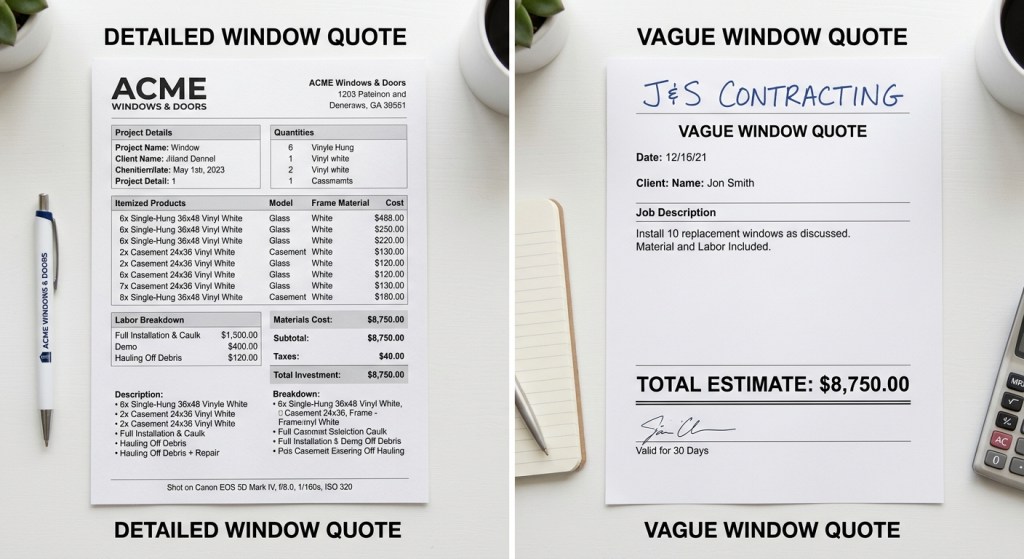
The pattern Raleigh Window Company sees repeatedly is homeowners focusing on the total number and missing structural warning signs in the document itself. Here are the ones that matter most.
No mention of glass package specifications. A quote that says “double-pane windows” without specifying the U-factor, Solar Heat Gain Coefficient (SHGC), or Low-E coating type gives you almost no information. The Department of Energy’s guidance on window performance ratings explains what those numbers mean and what to look for in a temperate versus cold climate. A contractor who cannot provide these specs either does not know them or is not buying quality product.
Verbal promises not in writing. If a salesperson tells you the crew will be done in two days, that is only meaningful if the contract says two days. In practice, the verbal-promise issue is where most disputes begin.
Pressure tactics around pricing. A quote that is only valid “for today only” is a sales tactic, not a real deadline. Material prices for standard vinyl windows do not fluctuate day to day. The National Association of Home Builders tracks construction material costs, and standard window pricing is relatively stable quarter to quarter.
The Real Cost Breakdown: What a Complete Quote Should Include
Here is what a complete, trustworthy window quote should itemize, broken into its actual components.
| Cost Component | Typical Range Per Window | Notes |
|---|---|---|
| Window unit (product only) | $150 to $650 | Varies by frame material and glass package |
| Standard installation labor | $100 to $300 | First-floor, accessible, no structural issues |
| Frame repair or build-out | $75 to $350 | Only if existing frame has damage or is non-standard |
| Haul-away and disposal | $15 to $50 | Some contractors include this; many do not |
| Permit fees | $50 to $200 | Varies by municipality; required in most jurisdictions |
These ranges align with the $517 per-window average reported by This Old House (2026). Your total will depend on which end of each range your specific project lands on, which is exactly why a site visit is necessary before any quote is treated as a real number.
Before you invite your first contractor over, read 5 mistakes homeowners make buying new windows so you know which assumptions to question during the quoting process.
The Fenestration & Glazing Industry Alliance’s 2024/2025 market study also found continued pressure on delivery timelines, which means ordering windows with a short lead time can create scheduling complications that add to total project cost.
What to Do After You Have Your Quotes
Once you have three or more itemized quotes, rank them not by price but by completeness. The most complete quote, with named products, itemized labor, written warranty terms, and a signed timeline, is almost always the safest choice even if it is not the cheapest.
Ask each contractor two direct questions before you sign: “What happens if installation reveals damage that was not visible during the site visit?” and “How do I reach you if something goes wrong six months from now?” The answers will tell you a great deal about how disputes get handled, which is more useful information than a discount.
Frequently Asked Questions
Q: How many quotes should I get for window replacement?
Get at least three quotes from licensed contractors before making any decision.
Two quotes give you a comparison, but three give you a pattern. If two of three quotes cluster near the same number and one is significantly lower, that outlier tells you something important, either about scope differences or about corners being cut. The This Old House Windows Survey (2026) found that 41% of homeowners got three or more quotes, and those homeowners reported fewer cost surprises at project completion.
Q: How long does it take to receive a window quote after requesting one?
Most window dealers deliver a quote within six days of a site visit, based on 2024 industry data.
Interconnection Consulting (2024) found the average quote turnaround shortened to 5.6 days, down from 6.7 days the prior year. That improvement reflects better quoting software and more standardized product catalogs across the industry. If a contractor takes longer than two weeks without explanation, that delay can signal scheduling problems that will carry into the installation itself.
Q: What is the average cost per window I should expect a quote to reflect?
The 2026 average is $517 per window, with full replacement projects averaging $7,183 (This Old House, 2026).
That per-window figure covers a mid-range vinyl double-hung unit with standard installation on an accessible first-floor wall. Your quote will land higher if you choose fiberglass frames, specialty shapes, or if the contractor discovers frame damage during the site visit. It will land lower if you are replacing a small number of identical windows in straightforward conditions and negotiate a volume discount.
Q: Can I get an accurate window quote over the phone or online without a site visit?
A phone or online quote is a rough estimate only, not a number you should use for budgeting.
Frame conditions, accessibility, structural issues, and local permit requirements are all invisible until a contractor physically inspects the site. More than 60% of homeowners said their final cost matched their original quote (This Old House, 2026), but that figure applies specifically to homeowners who had in-person assessments before signing. Remote quotes skip the variables that cause cost overruns, so treat any number you get without a visit as a starting point, not a commitment.
Q: What should I do if two window quotes are very far apart in price?
Call both contractors and ask each one to walk you through their line items before you dismiss either quote.
A large price gap usually traces back to one of three things: different product tiers (brand and glass package), different labor scope (one includes frame repair and haul-away, the other does not), or different warranty structures. Ask the lower-bidding contractor specifically whether their quote includes permit fees and disposal, since those two items are frequently excluded from budget bids. If the scope turns out to be identical and the gap is still large, the difference is usually labor rate or profit margin, and that is a legitimate negotiation point.
The Bottom Line on Getting a Reliable Window Quote
A window quote is only as useful as the information behind it. Homeowners who provide detailed prep work before contractors arrive, disclose visible frame damage, specify performance priorities, and ask for itemized breakdowns consistently report fewer surprises at final invoice. The data backs that up: over 60% of homeowners whose quotes matched their final cost had done exactly that kind of preparation upfront (This Old House, 2026).
The right action step right now is simple. Count your windows, note any frame damage you can see, write down your top performance priority (energy savings, noise reduction, or aesthetics), and then schedule site visits with at least three licensed contractors. Bring that same itemized checklist from the comparison table above to every meeting. A well-prepared homeowner gets a better quote, not because contractors charge less, but because there is no room left for ambiguity to become a cost overrun.
Research Sources
The data and claims in this article were drawn from the following sources, verified 2026.
- Fixr, Windows and Doors Report 2025: Residential Trends and Statistics
- Global Market Insights, Window and Door Frame Market Size, Growth Opportunity 2025-2034
- Interconnection Consulting, Windows: Market Report, Market Analysis, Market Data
- Consumer Affairs, Windows And Doors Statistics (2026)
- Window and Door, FGIA Releases 2024/2025 Market Study
- Woodworking Network, Fenestration group releases industry forecast for windows and doors