

Window Replacement Increases Home Value: What the Numbers Actually Show
New windows are one of the few home improvement projects that deliver returns in multiple ways simultaneously. Window replacement increases home value by improving energy efficiency, boosting curb appeal, and giving buyers confidence that the home has been well-maintained.
Key Takeaways
- The Zonda Cost vs. Value Report 2025 shows vinyl window replacement delivers up to 76% ROI at resale, recouping $16,657 on a $22,073 investment.
- Energy savings are a major secondary benefit: according to the U.S. Department of Energy, windows account for 25-30% of residential heating and cooling energy loss.
- ENERGY STAR certified windows save homeowners an average of 12% on annual energy costs, making them attractive to buyers focused on long-term affordability.
- The 2026 U.S. Houzz & Home Study found windows are the second most common exterior remodeling project, with 20% of surveyed homeowners replacing them.
- Curb appeal matters: buyers form first impressions within seconds, and visibly outdated or damaged windows can reduce perceived value before a showing even begins.
- Timing matters. Replacing windows before listing a home tends to produce stronger results than negotiating a credit after inspection.
Opening the conversation about home improvement ROI almost always leads back to one question: which projects actually pay off? Kitchens and bathrooms get most of the attention, but window replacement consistently ranks among the most reliable investments a homeowner can make. The data backs this up, and so does buyer behavior.
Why Buyers Pay More for Homes With New Windows
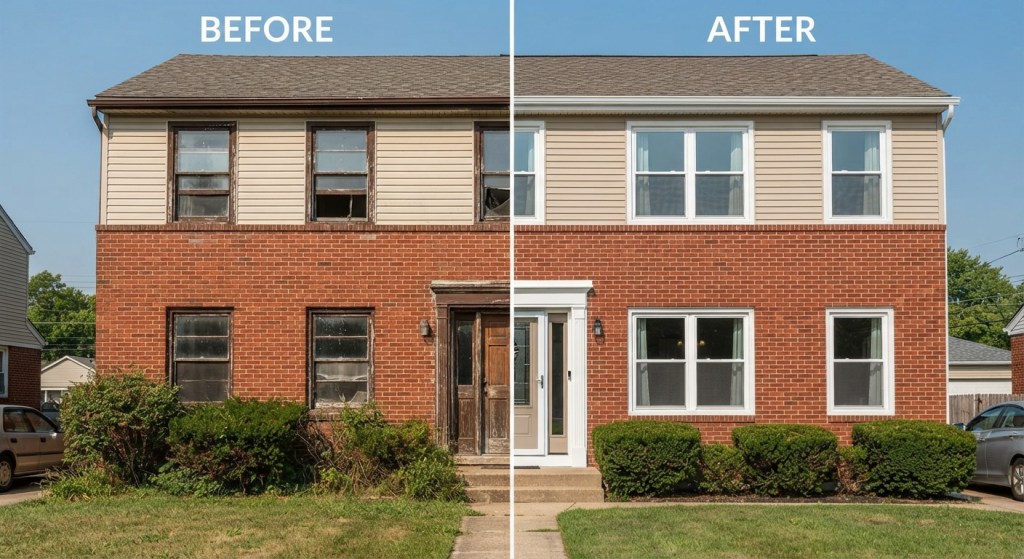
When buyers walk through a home, they are calculating two things at once: what they love about it and what they will have to fix. Old, drafty, or fogged-up windows land firmly in the second category. They signal deferred maintenance, uncomfortable rooms, and higher utility bills. New windows remove all three of those objections.
According to Opendoor’s research on home value, buyers consistently respond positively to homes where major systems and features have been recently updated, and windows fall directly into that category. The perceived value is often higher than the actual cost of replacement because buyers tend to overestimate what it would cost them to do the work themselves after closing.
There is also the energy efficiency angle, which has grown steadily more important to American homebuyers over the past decade. A February 2024 survey of 1,000 homeowners conducted by This Old House found that 27.8% cited energy efficiency as their primary factor when selecting window brands. A separate 2022 survey found that 91.7% of respondents said ENERGY STAR certification was important to them. When you install ENERGY STAR certified windows before selling, you are directly addressing what a significant portion of buyers are already looking for.
Beyond the sale itself, window replacement also reduces what buyers need to negotiate for during the inspection phase. Inspectors flag old windows regularly, and each flag gives buyers leverage to ask for price reductions. Replacing them beforehand neutralizes that pressure.
What the ROI Data Actually Shows
Return on investment figures for window replacement are well-documented and consistently positive, though they vary by window material, regional market, and how the installation is executed.
The Zonda Cost vs. Value Report 2025, the most cited benchmark in the remodeling industry, shows that vinyl window replacement carries an ROI of approximately 76%. Specifically, a vinyl window project costing $22,073 returns $16,657 in resale value. That is not a full dollar-for-dollar return, but it is strong for an exterior improvement project. The same report shows wood window replacements and mid-range alternatives recouping between 67% and 72%.

Angi reported in 2025 that some window replacement projects can yield up to 85% ROI depending on regional market conditions and installation quality. The wide range reflects real variation: a premium window installation in a competitive real estate market like Raleigh, North Carolina will typically outperform the same project in a slower market.
| Window Type | Estimated Project Cost | Resale Value Returned | ROI |
|---|---|---|---|
| Vinyl (mid-range) | $22,073 | $16,657 | 76% |
| Wood (mid-range) | Higher | Varies by region | 67-72% |
| Fiberglass (premium) | Higher | Higher in luxury markets | Varies |
| Budget aluminum | Lower | Lower buyer appeal | Lower |
These figures come from the Zonda/Remodeling Magazine Cost vs. Value Report 2025 and reflect national averages. Regional performance can shift these numbers meaningfully.
For a detailed breakdown of current pricing, the window replacement cost in 2026 page from Raleigh Window Company covers what homeowners in the Southeast can expect to pay based on window type, size, and installation complexity.
Energy Savings: The Value That Keeps Compounding
One of the strongest arguments for window replacement that goes beyond the sale price is ongoing energy savings. According to the U.S. Department of Energy, heat gain and heat loss through windows account for 25-30% of residential heating and cooling energy use. In a house where the HVAC system is working against poorly insulated single-pane windows, that inefficiency shows up every month on the utility bill.
ENERGY STAR windows reduce that burden significantly. The average homeowner saves approximately 12% on energy costs annually after upgrading to ENERGY STAR certified windows, according to ENERGY STAR program data. In states with hot summers and cold winters, those savings compound quickly.
For homeowners who are not planning to sell immediately, these savings represent real financial value independent of resale. For those who are preparing to sell, reduced utility bills are a documented selling point that can be shared with potential buyers, particularly in markets where energy efficiency is a priority.
The Department of Energy’s guidance on window efficiency provides a straightforward breakdown of how different window types perform across climate zones, which is useful for homeowners trying to choose the right product for their region.
Curb Appeal and the First Impression Factor

Real estate agents consistently point to curb appeal as one of the most influential factors in how quickly a home sells and at what price. Windows are a central component of a home’s exterior appearance. Cracked frames, yellowed vinyl, fogged double-pane units, and peeling paint around window casings all reduce the perceived quality of a home before a buyer steps inside.
New windows change the visual character of a house in ways that are immediately noticeable. Clean lines, fresh frames, and consistent styling across all windows create a coherent exterior that reads as well-maintained. The 2026 U.S. Houzz & Home Study found that windows are the second most common exterior remodeling project, with 20% of respondents replacing their windows in the prior year. That is not coincidence. Homeowners who have gone through the selling process know what buyers notice.
If you want a detailed breakdown of how the visual impact breaks down across different window styles and home types, the piece on 10 ways new windows improve curb appeal is worth reading before you finalize your selection.
How to Maximize the Value You Get From New Windows
Not every window replacement project delivers the same return. The following factors have a meaningful impact on how much value you actually recover.
Choose the right material for your market. Vinyl is the most cost-effective option for most American homeowners and delivers strong ROI in mid-range markets. Fiberglass offers superior performance and durability, which matters more in luxury market segments. Wood remains desirable in historic homes or high-end neighborhoods where the aesthetic premium is recognized by buyers.
Replace all visible windows at once if possible. A mix of old and new windows creates a visual inconsistency that buyers notice. Replacing only the worst performers can still help, but a full replacement reads better during showings and home inspections.
Use a licensed, insured contractor. Poor installation reduces both performance and resale value. Buyers and inspectors can often identify improper installation through visible gaps, condensation between panes, or frames that are not level. Raleigh Window Company, for example, handles full installations with certified crews so that the finished product performs as warranted.
Time your replacement appropriately. According to research shared by Stronghouse on window replacement ROI, homeowners who complete improvements before listing tend to recover more value than those who offer buyer credits after inspection. Pre-listing improvements signal confidence and remove a negotiating chip from buyers.
Consider window style alignment with your home’s architecture. A double-hung window suits a traditional colonial. A casement window works better on a contemporary or craftsman-style home. Style mismatches reduce the perceived quality of an otherwise solid installation.
Market Context: A Growing Industry With Sustained Demand
The window replacement and installation market is substantial and growing. One market analysis valued the sector at $12.5 billion in 2024, with projections reaching $20.1 billion by 2033, reflecting a 6.1% compound annual growth rate through 2033. A separate analysis projected growth from $33.35 billion in 2024 to $47.56 billion by 2031 at a 5.20% CAGR.
That growth reflects sustained consumer demand driven by aging housing stock, energy efficiency concerns, and ongoing interest in home improvement as a wealth-building strategy. Remodeling spending grew sharply in 2024 and is projected to maintain approximately 5% growth in 2025.
For homeowners in markets like Raleigh where housing prices have risen meaningfully over the past several years, the financial case for window replacement is even stronger. Higher baseline home values mean the dollar return on a 76% ROI project is larger in absolute terms than it would be in a lower-cost market.
According to insights shared by Green Builder Media on long-term window value, the durability of modern window products also plays into the value equation. Quality vinyl windows carry 20-25 year lifespans, meaning a replacement today is a selling point for years, not just for the next transaction.
Understanding Realistic Expectations
Window replacement delivers strong, documented value, but it is worth approaching it with realistic expectations. You will not recoup 100% of the cost at resale in most markets. What you will get is a meaningful return, lower energy bills while you live in the home, improved comfort, fewer inspection issues, and stronger buyer confidence at the point of sale.
The Zonda 2025 data showing 76% ROI for vinyl windows is a national average. Your specific return depends on your local market, your home’s price point, the quality of the installation, and the condition of your existing windows. In a competitive market where buyers have options, updated windows can be the differentiator that accelerates a sale at full asking price.
For homeowners in the Raleigh area evaluating this decision, Raleigh Window Company provides consultations that help match the right window product and installation scope to the specific home and market conditions.
Things to Know
- ROI is not the same as profit. A 76% ROI means you recover roughly three-quarters of what you spend, not that you earn money on top of your investment. The real gains come from faster sales, fewer negotiated concessions, and lower energy bills in the meantime.
- Not all windows are created equal for resale. Vinyl delivers the strongest ROI in most mid-range markets, but choosing a window style or material that clashes with your home’s architecture can undercut the value gain.
- Condensation between panes is a red flag for buyers. Failed seals in double-pane windows are one of the most common items flagged during home inspections. Even if the window is otherwise functional, fogged glass signals age and neglect to buyers and their agents.
- Federal tax credits may offset your upfront cost. ENERGY STAR certified windows can qualify for the Energy Efficient Home Improvement Credit under current IRS rules, potentially covering up to 30% of the cost up to a $600 cap per year. Check IRS Form 5695 for current eligibility details.
- Timing your replacement before listing matters. Research consistently shows that pre-listing improvements recover more value than buyer credits offered after inspection. A credit feels like a discount; new windows feel like a feature.
- Local market conditions affect your return. A window project in a high-demand market like Raleigh will typically outperform the national average ROI. Talk to a local contractor and a real estate agent together before deciding on scope and timing.
The Bottom Line on Window Replacement Increases Home Value
Window replacement increases home value through a combination of financial return, buyer confidence, and ongoing energy savings that few other projects can match simultaneously. The 2025 data is clear: vinyl window replacement delivers up to 76% ROI at resale nationally, and in competitive markets like Raleigh, that figure can climb even higher when paired with quality installation and the right product selection. Beyond the resale math, new windows reduce what buyers can negotiate against you, lower your monthly energy costs while you remain in the home, and give your property a cleaner, more maintained appearance from the street.
If you are considering a window replacement project, the next step is a professional assessment of your current windows and a project estimate that reflects your home’s specific needs. Raleigh Window Company works with homeowners across the Raleigh area to evaluate existing window conditions, recommend the right products, and deliver installations that hold up through inspections and over time. Reach out to Raleigh Window Company to schedule a consultation and get a clear picture of what replacement will cost and what it will return for your specific home.
Frequently Asked Questions
Q: Do new windows really add value to your home?
Yes, new windows do add measurable value to your home, both in resale price and in buyer appeal.
The Zonda Cost vs. Value Report 2025 shows vinyl window replacement returns approximately 76% of the project cost at resale, which translates to $16,657 recovered on a $22,073 investment at the national average. Beyond the dollar figure, new windows reduce inspection red flags, improve energy efficiency, and signal to buyers that the home has been well cared for. In competitive markets, that combination can be the deciding factor in a faster sale at a stronger price.
Q: What is the average cost to replace windows in a 2000 sq ft house?
The cost to replace all windows in a 2,000 square foot house typically ranges from $8,000 to $24,000 or more depending on window count, type, and installation complexity.
A standard 2,000 sq ft home generally has between 10 and 15 windows. Individual window replacement costs vary widely based on material, size, and style. Vinyl windows tend to sit at the lower end of the cost range, while fiberglass and wood command premium pricing. Labor costs also vary by region. For accurate current pricing in North Carolina, Raleigh Window Company provides project-specific estimates based on your home’s actual window count and condition.
Q: What increases a house’s value the most?
Kitchen remodels, bathroom updates, and exterior improvements including window replacement and new siding consistently rank among the highest-value home improvement projects at resale.
According to the Zonda Cost vs. Value Report 2025, exterior projects often outperform interior renovations in terms of ROI because they affect first impressions, inspection outcomes, and perceived maintenance quality simultaneously. Window replacement sits in a strong position within that group because it delivers both curb appeal and functional benefits like energy efficiency. Projects that address structural or system-level concerns, such as roofing, HVAC, and windows, also tend to reduce buyer negotiating leverage more effectively than cosmetic upgrades.
Q: What salary do you need to afford a $400,000 house?
As a general guideline, you typically need a gross annual income of around $100,000 to $120,000 to comfortably afford a $400,000 home under conventional lending standards.
Most lenders use the 28/36 rule, which suggests your monthly housing costs should not exceed 28% of your gross monthly income, and total debt payments should not exceed 36%. At a $400,000 purchase price with a standard 20% down payment and current interest rates, your monthly principal and interest payment would be roughly $1,900 to $2,200 depending on the rate. Adding property taxes, insurance, and potential HOA fees pushes the total monthly housing cost higher, which is why income requirements tend to land in the six-figure range for homes in this price bracket. A licensed mortgage lender can give you a precise figure based on your debt profile and local tax rates.
Q: What are the top 10 things that add value to your home?
The improvements that consistently add the most resale value include kitchen updates, bathroom renovations, window replacement, new siding, roof replacement, landscaping, garage door replacement, finished basements, fresh interior paint, and energy efficiency upgrades.
Each of these addresses something buyers actively evaluate during a showing or inspection. Kitchen and bathroom updates attract attention in listing photos and walkthroughs. Exterior projects like windows, siding, and garage doors shape the first impression before a buyer even enters the home. Energy efficiency improvements including ENERGY STAR windows and upgraded insulation speak to long-term ownership costs, which matter more to today’s buyers than they did a decade ago. According to the 2026 U.S. Houzz & Home Study, windows are the second most common exterior remodeling project, confirming that American homeowners already recognize their value. The best strategy is to prioritize improvements that address visible wear, pass inspection cleanly, and reduce the buyer’s perceived risk of ownership.