

What Are Double-Hung Windows? Everything Homeowners Need to Know
If you have ever shopped for windows and felt immediately overwhelmed by the terminology, you are not alone. Walk into any window showroom and you will encounter dozens of styles, dozens of frame options, and an alphabet soup of performance ratings. But one style consistently rises to the top for North American homeowners: the double-hung window.
Double-hung windows are the single most popular residential window style in the United States. They appear in homes ranging from 18th-century Colonial properties to contemporary new builds, and for good reason. Their design is elegantly functional, their performance is proven, and their versatility is unmatched by almost any other window style on the market.
This guide from Raleigh Window Company powered by McCloud Windows walks you through everything you need to know: what double-hung windows actually are, how every component works, what they cost, how they compare to single-hung windows, and how to decide whether they are the right choice for your specific home.
What Is a Double-Hung Window? The Anatomy Explained
A double-hung window is a vertically oriented window with two independently operable sashes, both of which slide up and down within the frame. This is what sets it apart from a single-hung window, where the upper sash is permanently fixed and only the lower sash moves.
That single functional difference, having two movable sashes instead of one, has a surprisingly large impact on ventilation, cleaning, safety, and long-term usability. To fully understand why, it helps to know what each component of a double-hung window actually does.
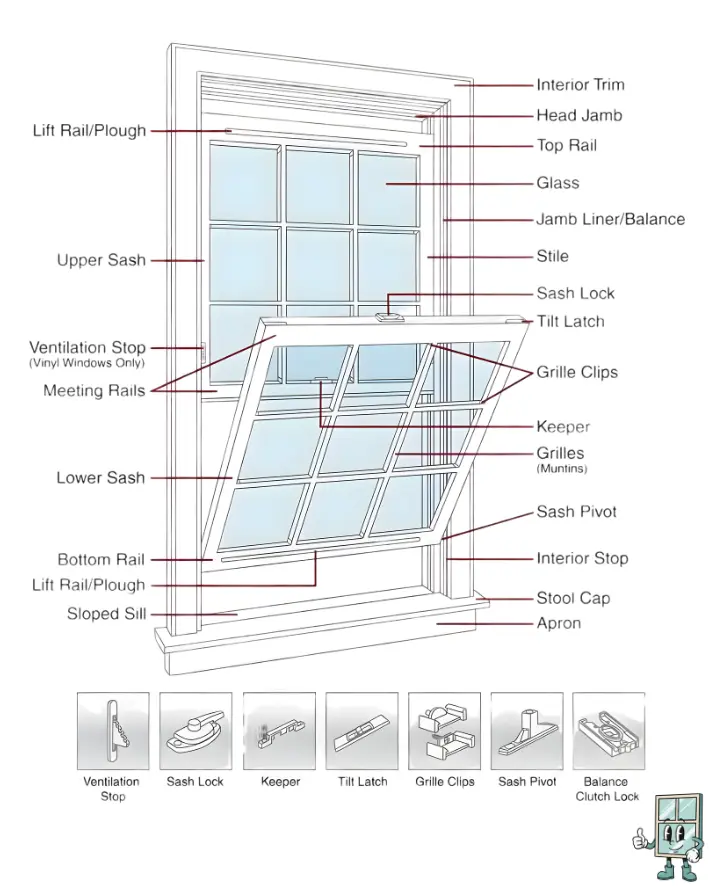
Key Components of a Double-Hung Window
| Component | What It Does | Why It Matters |
| Upper Sash | The top glass panel. Slides downward from the top of the frame. | Opening the upper sash lets warm air escape near the ceiling. Critical for passive ventilation. |
| Lower Sash | The bottom glass panel. Slides upward from the sill. | Primary ventilation path. Allows cool air to enter at floor level. |
| Meeting Rail | The horizontal bar where upper and lower sash meet in the middle. | Houses the locking mechanism. A well-sealed meeting rail reduces air infiltration. |
| Sash Balancers | Spring or block-and-tackle mechanisms that counterbalance sash weight. | Allow sashes to stay open at any position without sliding down on their own. |
| Tilt-In Latches | Small pivot mechanisms on each sash that allow the sash to tilt inward. | Enable interior cleaning of exterior glass surfaces. Essential for upper-floor windows. |
| Weep Holes | Small drainage channels at the base of the frame. | Prevent water pooling inside the sill. Critical for preventing rot and moisture damage. |
| Weatherstripping | Flexible seals along all sash edges that contact the frame. | Minimize air infiltration and water penetration when the window is closed. |
How Double-Hung Windows Work: Ventilation Science Made Simple
The real genius of a double-hung window is not just that two sashes move. It is that the two sashes together create a natural convection system that improves airflow in ways that a single operable sash simply cannot.
Here is the physics in plain language: warm air is lighter than cool air, so it naturally rises toward the ceiling. If you open only the lower sash of any window, you are creating an entry point for fresh air but no dedicated exit for the warm, stale air already in the room. You get air movement, but you do not get air exchange.
When you open both sashes of a double-hung window simultaneously, something different happens. Cool air enters through the open lower sash at floor level. The warm, lighter air near the ceiling finds a path out through the open upper sash. This creates a continuous convection loop: in at the bottom, out at the top. The result is a room that ventilates more thoroughly using less energy.
Passive Ventilation by the Numbers
- Double-hung windows with both sashes open create measurable convection-loop airflow that can reduce mechanical cooling usage by 20 to 30 percent during mild spring and fall weather. (Source: Five Seasons Windows, 2025 installation benefit study)
- Homes with double-pane glass installed in double-hung frames achieve nearly 80 percent greater energy efficiency than comparable homes retaining original single-pane windows. (Source: Modernize, citing industry insulation data, 2025)
- Recent real estate studies show double-hung window installations return 78 to 85 percent of project cost at resale, outperforming more specialized window styles that return 65 to 75 percent. (Source: National Association of Realtors, cited in Five Seasons Windows report, 2025)
- ENERGY STAR certified double-hung windows can qualify for federal tax credits of up to $600 per year under current Inflation Reduction Act provisions. (Source: energystar.gov, 2025)
7 Genuine Benefits of Double-Hung Windows (And the Trade-Offs to Know)
Competing window guides tend to list benefits without context. Here is an honest look at what double-hung windows genuinely do well, alongside the limitations every homeowner should understand before buying.
Benefit 1: Superior Two-Direction Ventilation
No other standard residential window style lets you direct airflow from both the top and bottom simultaneously. This is double-hung’s defining advantage. In Raleigh’s hot summers, this passive ventilation capability is practically valuable: opening the upper sash in the evening allows heat that accumulated near the ceiling all day to escape while cooler outdoor air enters from below.
Benefit 2: Interior Cleaning Access on Any Floor
Both sashes tilt inward on modern double-hung windows, which means you can clean the exterior glass surface from inside your home. For second and third floor windows, this eliminates the need for ladders, scaffolding, or professional window cleaning services. This is the feature homeowners mention most often after living with double-hung windows for a full year.
Benefit 3: Child and Pet Safety Without Sacrificing Airflow
Because the upper sash operates independently, you can open it for ventilation while keeping the lower sash closed. This prevents children and pets from accessing the open lower sash while the room still benefits from air circulation. Some double-hung models also include sash stops, which limit opening width as a secondary safety measure.
Benefit 4: Architectural Versatility
Double-hung windows are available in widths from 24 inches to 48 inches and heights from 36 inches to 72 inches, with custom sizing available for historic homes that require precise matching. They pair with virtually every residential architectural style because their vertical proportions and symmetrical sash layout complement everything from Georgian Colonial to Craftsman to farmhouse to contemporary.
Benefit 5: Wide Range of Frame and Glass Options
Double-hung windows are manufactured in vinyl, fiberglass, wood, aluminum, and composite frames. They accept single, double, and triple pane glass packages. They can be ordered with Low-E coatings, argon or krypton gas fill, decorative grilles, and tinted glazing. This flexibility makes them appropriate for virtually any performance target and any budget range.
Benefit 6: Broad Availability and Standard Sizing
Because they are the most widely produced residential window style in North America, double-hung windows are stocked by nearly every window supplier. Standard sizing keeps costs lower, speeds up installation, and makes future replacement significantly easier. If a unit fails outside warranty coverage 15 years from now, a standard-size replacement is almost certainly available from multiple sources.
Benefit 7: Long Service Life
Well-manufactured double-hung windows installed correctly by a certified professional carry service life expectations of 20 to 40 years depending on frame material and climate conditions. Vinyl frames are the most corrosion-resistant in North Carolina’s humid climate. Fiberglass frames offer the longest service life of any material and the lowest expansion and contraction response to temperature change.
The Real Trade-Offs to Know
No window style is perfect. Here is what you should weigh before committing to double-hung windows for every opening in your home.
| Trade-Off | What It Means | How to Mitigate It |
| Slightly more air leakage potential than casement | Two operable sashes mean two meeting rails where air can infiltrate. | Choose high-quality weatherstripping; casement windows press the sash against the frame like a refrigerator seal, but well-manufactured double-hung units close this gap significantly. |
| More hardware means more maintenance points | Two sash balancers, two sets of tilt latches, more weatherstripping. | Annual track cleaning and light lubrication (silicone spray, not WD-40) keeps hardware operating smoothly for years. |
| Slightly higher cost than single-hung | Dual operating sash requires more components and manufacturing. | The cost difference between single-hung and double-hung is generally $50 to $150 per window, often worth the functional upgrade. |
Double-Hung vs. Single-Hung Windows: Which Is Right for Your Home?
This is the comparison most homeowners encounter first, and it deserves a direct, useful answer rather than a vague ‘it depends.’ Here is a practical breakdown.
| Factor | Double-Hung | Single-Hung |
| Ventilation | Excellent: both top and bottom sashes open | Good: lower sash only |
| Cleaning | Interior cleaning of both glass surfaces via tilt-in sashes | Lower interior easy; upper exterior requires ladder or professional cleaning |
| Child and Pet Safety | Open upper sash only while lower stays closed | Opens only from the bottom, creating a floor-level fall risk |
| Air Infiltration | Slightly more potential at dual meeting rails | Marginally lower due to fixed upper sash |
| Cost (Supply) | Approximately $450 to $850 per window (supply only) | Approximately $300 to $600 per window (supply only) |
| Architectural Variety | Wider range of grille patterns, colors, and custom options | Good variety but fewer specialty configurations |
| Best Use Case | Multi-story homes, bedrooms, living rooms, anywhere cleaning access matters | Ground floor rooms, tight budgets, spaces where ventilation is not a priority |
The practical summary: double-hung windows are the better choice for most residential applications, particularly in multi-story homes where cleaning access and ventilation flexibility matter. Single-hung windows are a reasonable option for ground-floor windows in rooms where you have easy exterior access and ventilation requirements are minimal.
Choosing the Right Frame Material for Your Double-Hung Windows
Once you have decided on double-hung as your window style, the next major decision is frame material. In Raleigh’s climate, which combines hot and humid summers with mild but damp winters, certain frame materials perform better over the long term than others.
Vinyl Frames
Vinyl is the most popular frame material for double-hung windows in North Carolina and across the Southeast. It does not absorb moisture, does not require painting, resists warping and cracking, and provides good thermal performance due to multi-chamber construction that traps air within the frame profile. According to 2019 LBNL residential window market research, vinyl holds the dominant share of the U.S. residential replacement window market. The cost-to-performance ratio is strong for most Raleigh homeowners.
Fiberglass Frames
Fiberglass is the premium choice. It expands and contracts at almost the same rate as glass, which means the seal between frame and glass stays tight through temperature swings. Fiberglass frames carry the longest service life expectation of any material, are paintable (unlike vinyl), and are appropriate for both traditional and contemporary architectural styles. The upfront cost is higher, but the total cost of ownership over 30-plus years is often lower than vinyl due to reduced maintenance and longer replacement cycles.
Wood and Clad-Wood Frames
Wood frames offer genuine natural beauty and excellent insulation through the frame itself. For Raleigh homeowners considering wood, clad-wood options, which have a weather-resistant exterior shell of aluminum or fiberglass over a wood interior, are strongly recommended. They provide the warm aesthetic of painted or stained wood on the inside while the exterior cladding handles humidity and UV exposure without painting. Wood frames require more maintenance than vinyl or fiberglass and are priced accordingly.
Aluminum Frames
Aluminum frames are common in commercial applications but less ideal for residential double-hung windows because aluminum conducts heat very efficiently, which works against your insulation goals. For contemporary or industrial architectural styles where slim sightlines are important, thermally broken aluminum frames (which include a non-conductive separator in the frame profile) improve thermal performance significantly.
Glass Performance: What the Numbers on Your Window Label Mean
The NFRC (National Fenestration Rating Council) label is the standardised performance rating found on every certified window sold in the United States. Understanding two numbers will make you a significantly more informed buyer.
U-Factor: Your Insulation Score
U-factor measures how readily heat flows through the window assembly from indoors to outdoors or vice versa. The scale runs from 0.20 to 1.20, and lower is better. For Raleigh, North Carolina, which sits in ENERGY STAR’s South/Central climate zone, look for a U-factor of 0.30 or below. ENERGY STAR V6 certification for this climate zone currently requires a U-factor of 0.27 or lower.
Solar Heat Gain Coefficient
Solar Heat Gain Coefficient, abbreviated SHGC, measures the fraction of solar radiation that passes through the glass into your home. It ranges from 0 to 1, and lower values mean less solar heat gain. In Raleigh’s warm climate, a lower SHGC on south- and west-facing windows reduces summertime cooling load. For north-facing windows where you actually want some solar gain in winter, a slightly higher SHGC can work in your favor.
Standard Double-Hung Glass Package Recommendations for Raleigh, NC
- Glass package minimum: Double-pane with Low-E coating and argon gas fill
- Target U-factor: 0.27 or lower for ENERGY STAR compliance in North Carolina
- Target SHGC: 0.25 or lower for south and west-facing windows in Raleigh
- Upgrade option: Triple-pane for bedrooms adjacent to high-traffic roads or for extreme energy efficiency goals
- Triple-pane advantage: Recent studies indicate triple-pane glass can improve window energy performance by up to 40 percent compared to double-pane equivalents, with additional noise reduction benefits. (Source: Ply Gem, 2025)
How Much Do Double-Hung Windows Cost in 2025?
One of the first questions homeowners ask is what they should expect to pay. Here is a transparent breakdown based on current market data for the Raleigh, NC area.
| Cost Factor | Range | Notes |
| Standard vinyl double-hung (supply only) | $300 to $600 per window | Most common residential specification in NC |
| Premium fiberglass or wood-clad (supply only) | $600 to $1,200 per window | Higher performance, longer service life |
| Professional installation (labour per window) | $100 to $300 per window | Varies by floor level, complexity, and installer |
| Average total cost per window (supply + install) | $450 to $850 per window | Source: EcoWatch energy-efficient windows report, 2025 |
| Full-home replacement (10 to 15 windows) | $5,500 to $15,000+ | Depends on count, style, and material tier |
| ENERGY STAR federal tax credit | Up to $600 per year | Verify current eligibility with your tax professional |
| ROI at resale | 78 to 85 percent | Source: National Association of Realtors, 2025 data |
A note on pricing transparency: quotes in the Raleigh market can vary substantially between companies. The labour rate from a nationally franchised installer and the rate from a locally owned, manufacturer-certified shop may differ by $40 to $80 per window. The difference is not always quality, but local companies often offer more direct accountability, faster service, and better knowledge of local code requirements.
How to Maintain Double-Hung Windows for Maximum Lifespan
The dual-sash design of double-hung windows makes them the easiest standard window style to maintain because both glass surfaces are accessible from inside. A basic routine, performed twice a year, keeps double-hung windows operating smoothly and extends their service life by years.
Seasonal Maintenance Checklist
Spring Maintenance (April)
- Tilt both sashes inward and clean all glass surfaces with a non-ammonia glass cleaner.
- Wipe down sash channels, tracks, and sill with a damp cloth to remove winter grime and debris.
- Inspect weatherstripping along all sash edges. Press it firmly, it should spring back. If it stays compressed or shows cracking, schedule replacement.
- Apply a thin coat of silicone-based lubricant (not oil or WD-40) to the sash channels and pivot bars to ensure smooth tilt operation.
- Test the locking mechanism at the meeting rail. It should engage and release cleanly with no rattling when locked.
Fall Maintenance (October)
- Repeat glass cleaning and track cleaning as above.
- Check exterior caulking around the entire window frame perimeter. Any gaps, cracks, or separations should be recaulked before winter to prevent air and water infiltration.
- Inspect weep holes at the base of the frame. Clear any debris blocking the drainage channels.
- Confirm sash balancers are functioning. A sash that drops on its own when released indicates a worn balancer that needs attention before heavy seasonal use.
For vinyl and fiberglass frames, no painting or staining is needed. For wood or clad-wood frames, inspect the exterior cladding annually and repaint any bare wood within one season of exposure to prevent moisture infiltration.
Is a Double-Hung Window the Right Choice for Your Home?
The honest answer for most Raleigh homeowners is yes, double-hung windows are the right choice for the majority of openings in a residential home. They are not, however, the right choice for every single situation. Here is a quick decision guide.
| Situation | Best Choice | Why |
| Bedroom on any floor | Double-hung | Tilt-in cleaning, upper sash ventilation with child safety |
| Kitchen above counter | Casement | Easier to open by cranking rather than lifting sash |
| Living room focal point | Picture window + flanking double-hung | Picture window maximises view; flanking operable units provide air |
| Bathroom needing privacy and air | Double-hung with obscure glass | Upper sash opening for air while maintaining visual privacy |
| Historic home requiring authentic look | Double-hung with divided light grilles | Most architecturally appropriate style for pre-1950 homes |
| Tight budget, ground floor | Single-hung | Saves $50 to $150 per window where upper sash cleaning is easy |
| Room adjacent to busy road | Double-hung with triple-pane | Noise reduction benefit of third pane worthwhile for comfort |
The Bottom Line on Double-Hung Windows
Double-hung windows earned their position as the most popular residential window style in America because they genuinely do more than any other standard window configuration. Two independently operable sashes create ventilation options that a single sash simply cannot. Tilt-in cleaning access makes ownership easier over a 20 to 40 year lifespan. The combination of architectural versatility and broad frame and glass options means there is a double-hung configuration that works for nearly every home style and budget.
The performance you get from a double-hung window, however, depends heavily on the quality of the unit you choose and the quality of the installation. A poorly installed premium window will underperform a correctly installed mid-grade window. Measurement accuracy, flashing, air sealing, and sash alignment all matter.
Talk to a Window Company Near Me You Can Actually Trust
At Raleigh Window Company powered by McCloud Windows, our certified installation team has been helping homeowners across the Raleigh area choose and install double-hung windows that perform the way they are designed to perform.
Whether you are replacing one window or all of them, our Window Services Near You include a free in-home consultation, accurate measurements, and a written quote with no pressure and no surprises. If you are searching for a reliable Window Company near me in Raleigh, NC, we would love to earn your trust.